
Claude Fable 5.2 vs. Gemini 4 Carbon vs. GPT-6 Astra for Branching Character Scenes
Compare Claude Fable 5.2, Gemini 4 Carbon and GPT-6 Astra with a robot-gardener story brief, continuity checks and dated API-cost arithmetic.
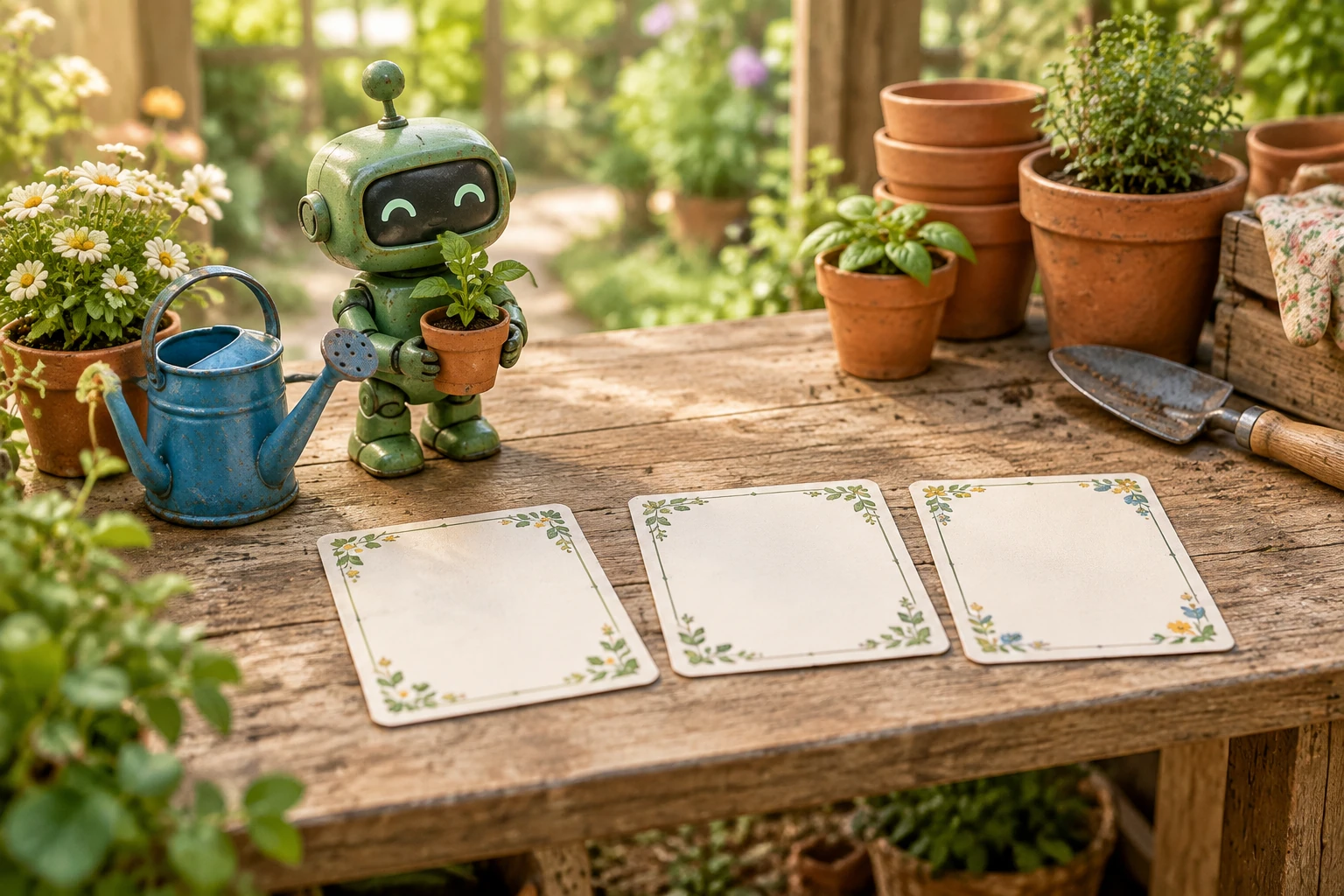
For creators planning an original branching character scene, Claude Fable 5.2, Gemini 4 Carbon, and GPT-6 Astra can be compared with the same brief and a careful human review—not assumed to produce the same result. This page gives you an original three-scene story plan, continuity invariants, one shared prompt, a blank review ledger, suggested manual checks, and a dated API arithmetic example. The exercise is proposed, not a report of model tests or outputs.
What's new on this page
- 2026-11-14 — Page published. Added an original three-scene robot-gardener brief, explicit blue-watering-can invariants, a reusable prompt, and a blank comparison worksheet.
Start with the story brief
Character: Pip, a small green robot gardener.
Goal: Help a drooping moonflower recover before its first nighttime bloom.
Scene 1 — The dry bed: Pip discovers the moonflower’s soil is dry. Choice A: loosen the soil gently. Choice B: clear a fallen leaf from the bed.
Scene 2 — A small obstacle: A pebble blocks the narrow path to the water barrel. Choice A: move it to the path’s edge. Choice B: take a wider route around it.
Scene 3 — The evening check: The flower’s leaves lift slightly as dusk approaches. Choice A: mark the bed for a morning check. Choice B: tidy the nearby path before leaving.
Treat each choice as a branch from the preceding state. The story can change its action and details, but it should not quietly rewrite established facts to make a sentence sound smoother.
Continuity invariants
Keep these facts true in every branch:
- Pip is a small green robot gardener.
- The watering can is blue, and it remains the same can throughout the story.
- Pip carries the blue watering can from Scene 1 onward; no branch loses, swaps, recolors, or duplicates it.
- The moonflower begins drooping in dry soil. Do not claim it is fully recovered or blooming unless the story establishes that change.
- Scene 2 follows the Scene 1 choice; Scene 3 follows both earlier choices. Do not skip a scene or reset the path without saying so.
The blue can’s color and identity are continuity facts, not decorative suggestions. A beautifully phrased branch that turns it red, makes it disappear, or introduces a second can has a state error.
A shared prompt for Claude Fable 5.2 and the alternatives
Copy the brief and invariants above, then use this prompt unchanged for Claude Fable 5.2, Gemini 4 Carbon, and GPT-6 Astra:
Write this as a branching character scene in three numbered scenes. For each scene, provide a short narration followed by exactly two labeled choices, A and B. Keep each choice’s consequence available to later scenes; do not write a single linear ending that ignores earlier choices. Preserve every continuity invariant supplied in the brief. Do not invent a recovery, bloom, watering action, or change of prop unless the text establishes it. Keep narration concise and distinguish what Pip observes from what Pip does. Return only the three scenes and their choices.
For a useful manual comparison, keep the shared brief and requested length fixed. Record each model’s supported settings and preserve them across its own attempts; equally named reasoning settings need not represent equal work across providers. Record any changes rather than quietly revising one model’s prompt. This is a way to compare external text-planning work; it does not test native image or video generation, or establish availability on this site. Tool-enabled media generation is separate from the text exercise.
Review ledger: leave it blank until you run your own comparison
Use a separate copy of these checks for each model. Record your own observations after a run.
- Exactly three scenes? Observation: [write your note].
- Exactly two choices per scene? Observation: [write your note].
- Choice consequences carry forward? Observation: [write your note].
- Blue can stays the same can and color? Observation: [write your note].
- Moonflower state changes only when established? Observation: [write your note].
- Any invented prop, reset, or skipped branch? Observation: [write your note].
- Wording clear enough to follow? Observation: [write your note].
- Prompt, settings, and output length recorded? Observation: [write your note].
Suggested manual checks
First, audit the state, not the style: trace each A/B route through all three scenes and note Pip’s location, the flower’s condition, and the can’s identity. Second, test choice transitions: after a reader selects A in Scene 1, does Scene 2 reflect that route, or could it have followed B without contradiction? Attractive prose earns no credit for a broken transition. Third, check structure and clarity: count scenes and choices, mark any ambiguous option, and see whether a reader can tell what action each choice takes. Record observations in your own words; do not turn a single run into a universal model ranking.
Dated API cost example—not site credits
Official standard API rates available on November 14, 2026: Claude Fable 5.2 costs $8 per million input tokens and $40 per million output tokens (official rates); its announcement date was November 9, 2026 (official announcement). Gemini 4 Carbon’s introductory rates are $2 input and $10 output per million; the introductory period expires November 30, 2026, with later rates of $4 and $20 (official announcement and rate footnote). GPT-6 Astra standard rates are $10 input and $50 output per million (official rates).
At those rates, 10,000 uncached billed input tokens plus 2,000 billed output tokens—including any reasoning—cost $0.16 for Claude Fable 5.2, $0.04 for Gemini 4 Carbon at its introductory rate, $0.08 for Gemini 4 Carbon afterward, and $0.20 for GPT-6 Astra. This is illustrative arithmetic, not a measured run or cost per successful story. Retries, caching, tool fees, and settings can change totals. GPT-6 Astra requests with more than 272K input tokens have different applicable pricing, so do not use this standard-rate example for them.
API dollars are not this site’s credits. Check pricing for site-related pricing information, and browse the blog for more creator guides. The numbers above alone cannot tell you which model will make the most useful branches for your project.
Carry one accepted scene into artwork
Choose a scene only after its choice transitions and prop details pass your checks. Then take that scene’s confirmed visual brief to the image generator, select an available model and inspect its current credit quote. Compare the artwork with the character and prop anchors before continuing to the next scene.